

Barlas Tolan Conferences
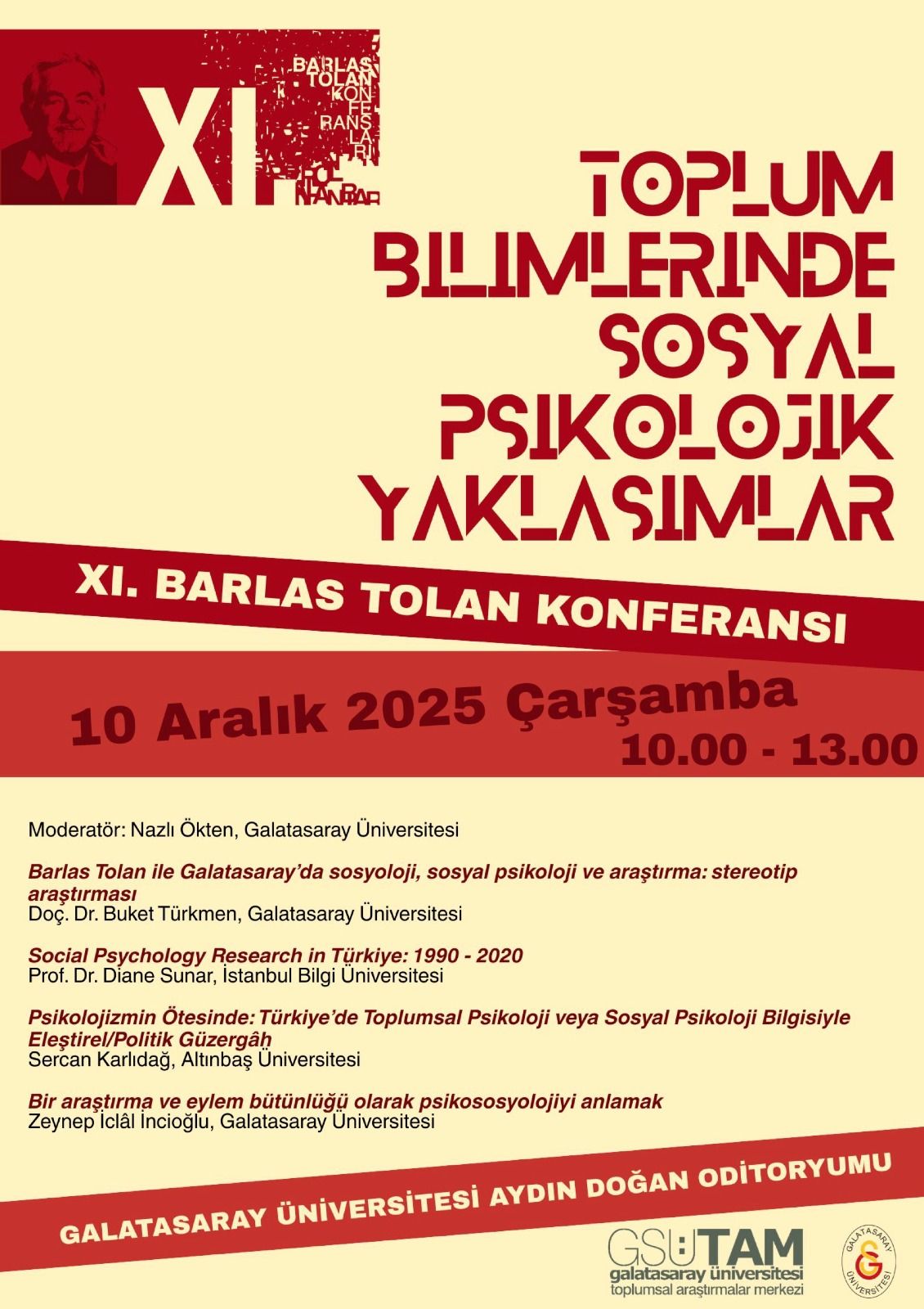
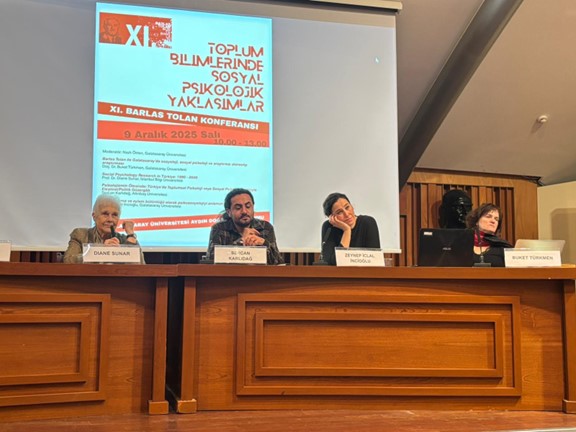
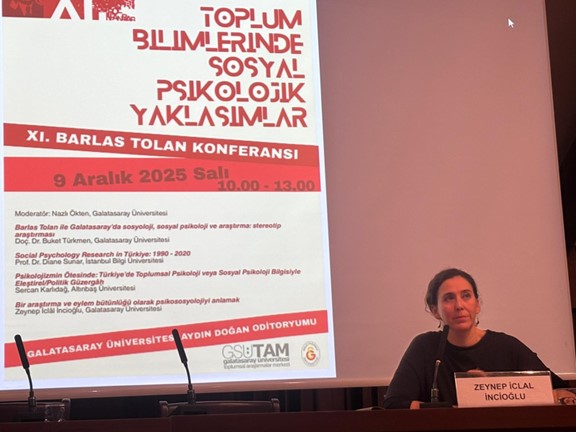
Barlas Tolan, one of the founding members of Galatasaray University and the founding chair of the Department of Sociology, passed away eleven years ago. Following his passing, the Barlas Tolan Conferences, organized annually by the Department of Sociology in his memory, have become a regular event. The 11th edition of the conference was dedicated to one of the fields of study to which Professor Tolan attached particular importance: social psychology. Held on 9 December 2025 at the Aydın Doğan Auditorium, this year’s conference was titled “Social Psychological Approaches in the Social Sciences.”
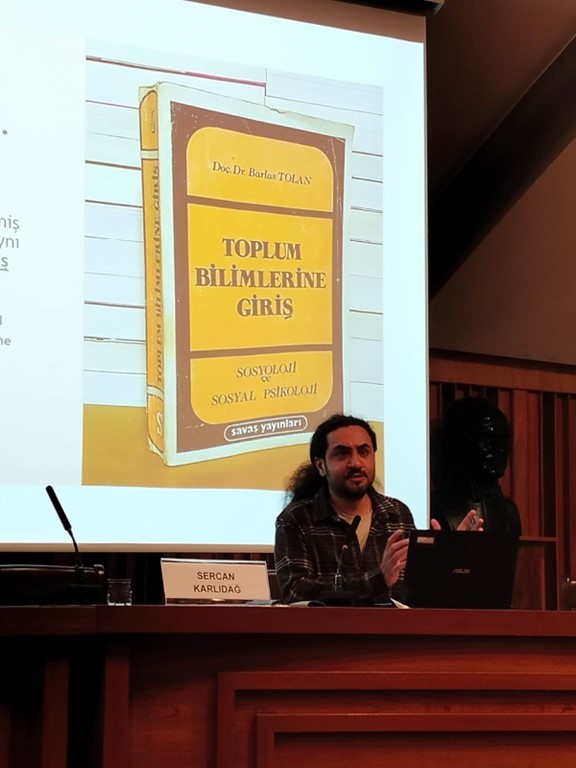
The conference featured presentations by Prof. Dr. Diane Sunar (Istanbul Bilgi University), Assoc. Prof. Dr. Buket Türkmen (Galatasaray University), Dr. Sercan Karlıdağ (Altınbaş University), and Zeynep İclal İncioğlu (Galatasaray University). The session was moderated by Nazlı Ökten (Galatasaray University).
In her opening remarks and as the organizer of the conference, Assoc. Prof. Dr. Buket Türkmen referred to the 1999 study on stereotypes and identity that established a link between Galatasaray University and Barlas Tolan. Entitled “A View of the World from Turkey: The Image of Europeanness in Turkey and Its Effects on the Construction of National Identity,” the study, published by Galatasaray University Press, was conducted by a research team composed of scholars from different disciplines and employing diverse approaches. One of the points emphasized during the talk was that the research assistants who took part in the project at the time have since become accomplished academics in their respective fields.
Türkmen also noted that the research was organized by Barlas Tolan in a horizontal and participatory manner, and that this approach was reflected both in the research process and in the publications that emerged from it. Reflecting on the methods and analyses used in the study from today’s critical perspective, Türkmen concluded her speech by stating: “We looked back very critically, as we do with all of our first research projects. But without the first ones, the later ones would not have been possible.”
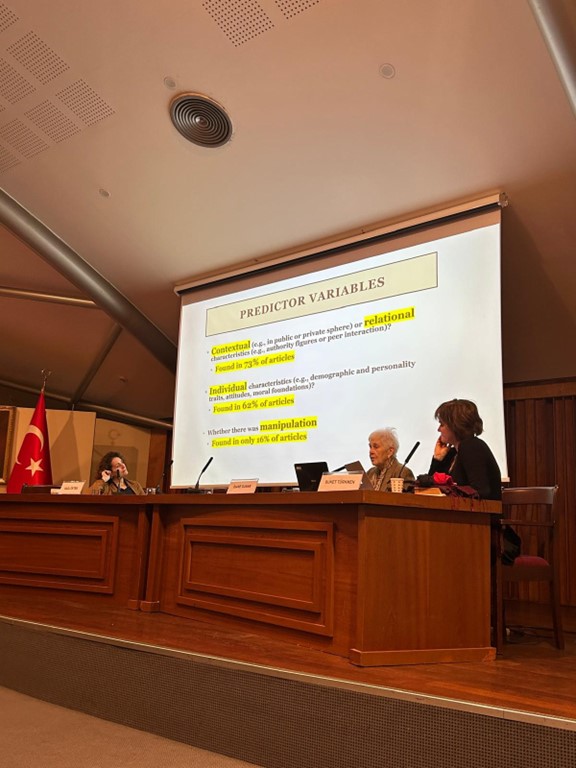
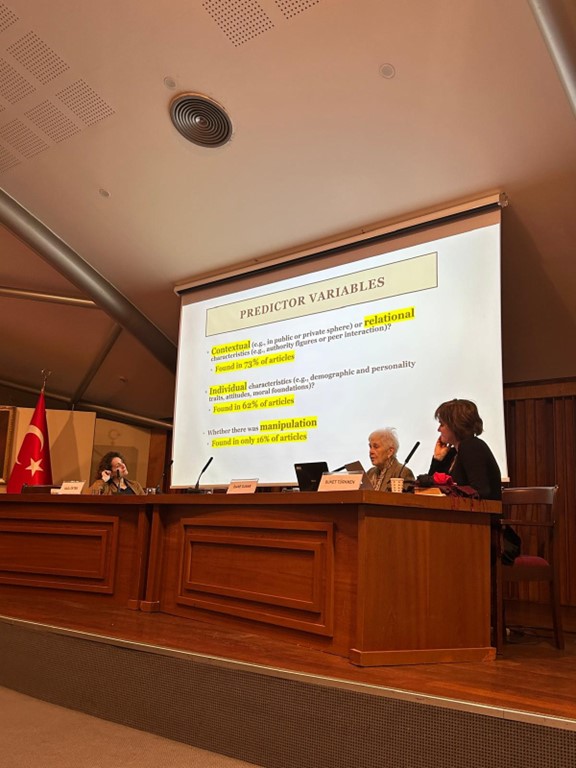
For a conference devoted to this topic, it was only fitting that one of the leading figures in the field, widely regarded as the “teacher of teachers,” Prof. Dr. Diane Sunar (Istanbul Bilgi University), was invited. Sunar opened the session with her presentation, delivered in English, entitled “Social Psychology Research in Türkiye: 1990–2020.” The audience, who welcomed Sunar’s participation with great enthusiasm, had the opportunity to follow the trajectory of social psychology in Türkiye through her presentation.
Sunar emphasized that the social transformations experienced in Türkiye since the 1990s have brought about significant changes in family structures, values, processes of identity formation, and perceptions of gender. She highlighted that these transformations have had a decisive impact on the questions addressed and the methods employed in social psychological research. She noted that the issue of the “self,” which had previously been one of the central concerns of social psychology, was gradually abandoned, and that social transformations came to be examined primarily through scientific methods based on correlations and statistical analyses.
In both her presentation and the discussion at the end of the session, Prof. Sunar underlined that her approach to science is one that maintains a distance from the political sphere and places importance on neutrality, emphasizing the significance of this scientific stance.
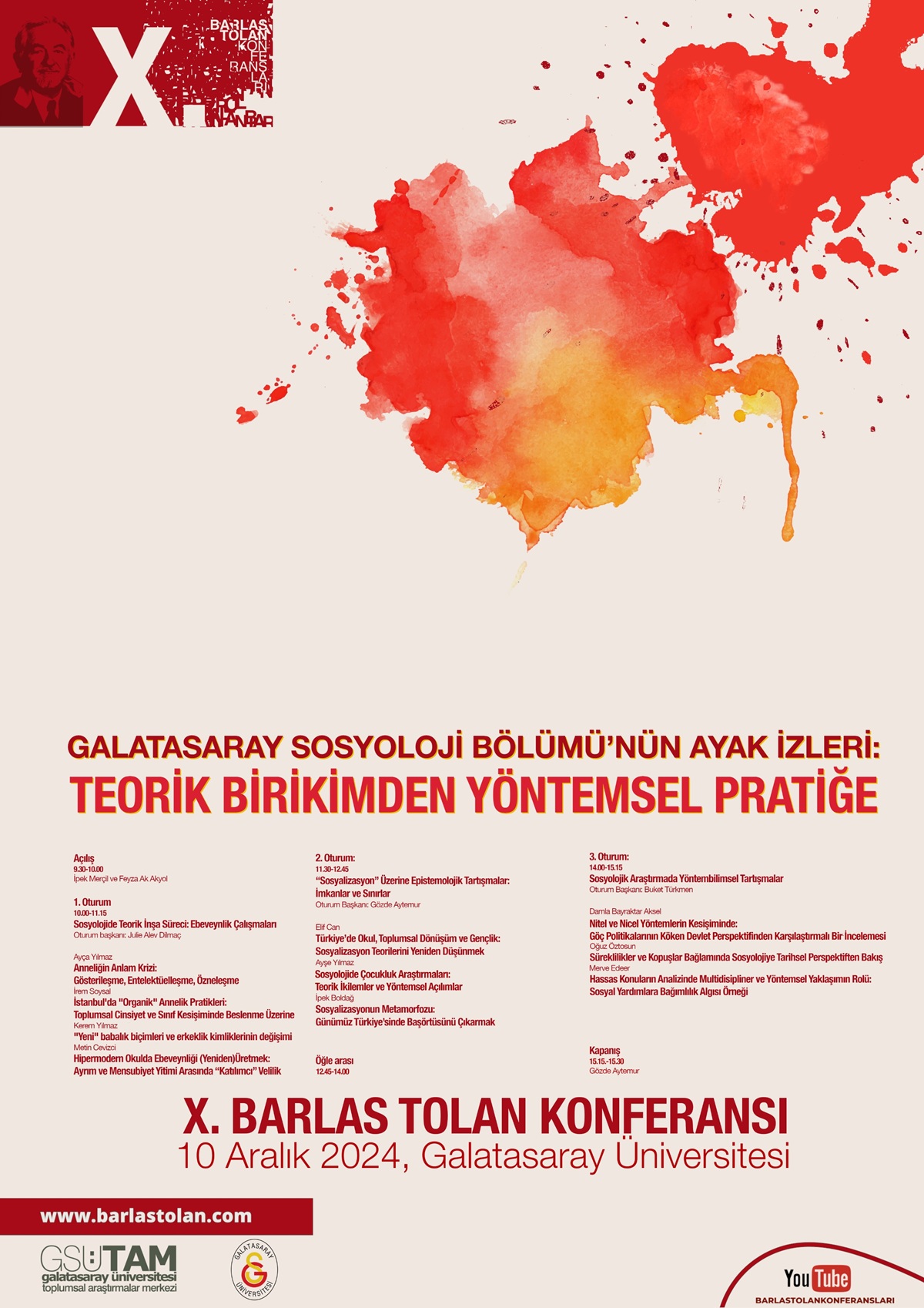
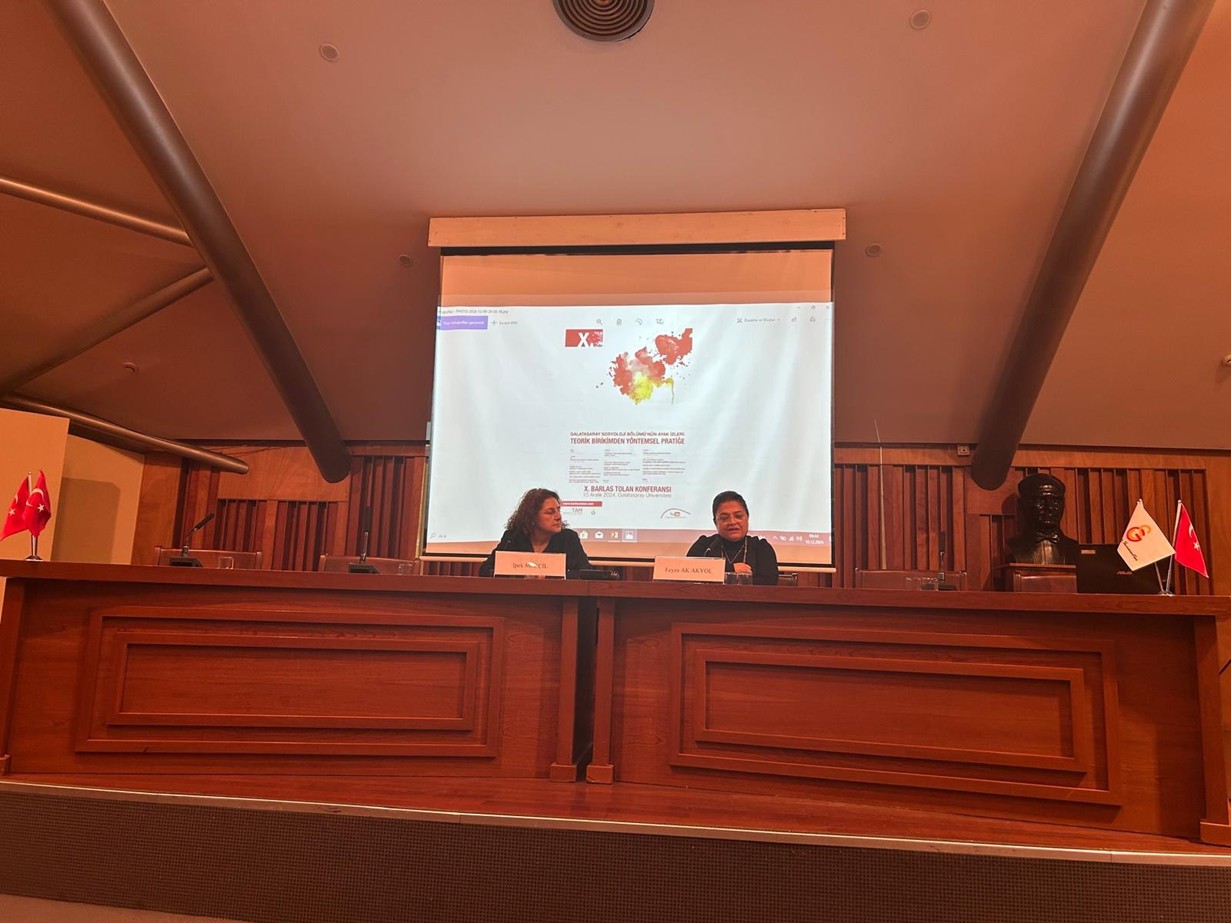
As the Department of Sociology at Galatasaray University, we successfully held the tenth edition of the traditional Barlas Tolan Conferences on Tuesday, 10 December 2024. This year’s event, entitled “The Legacy of the Galatasaray Sociology Department: From Theoretical Foundations to Methodological Practice”, was organized to commemorate our department’s founding chair, Prof. Dr. Barlas Tolan, and to carry his academic legacy forward to future generations.
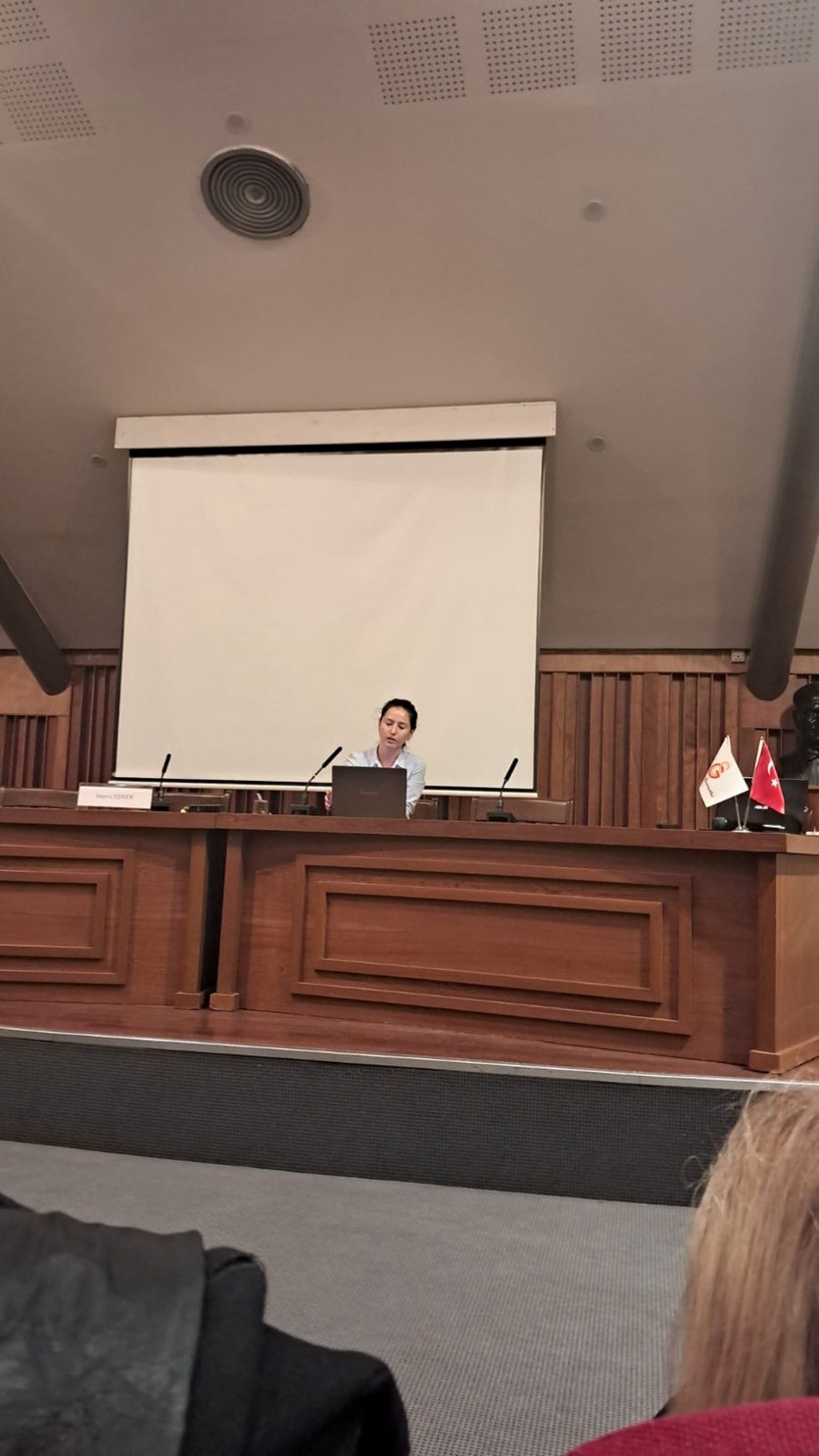
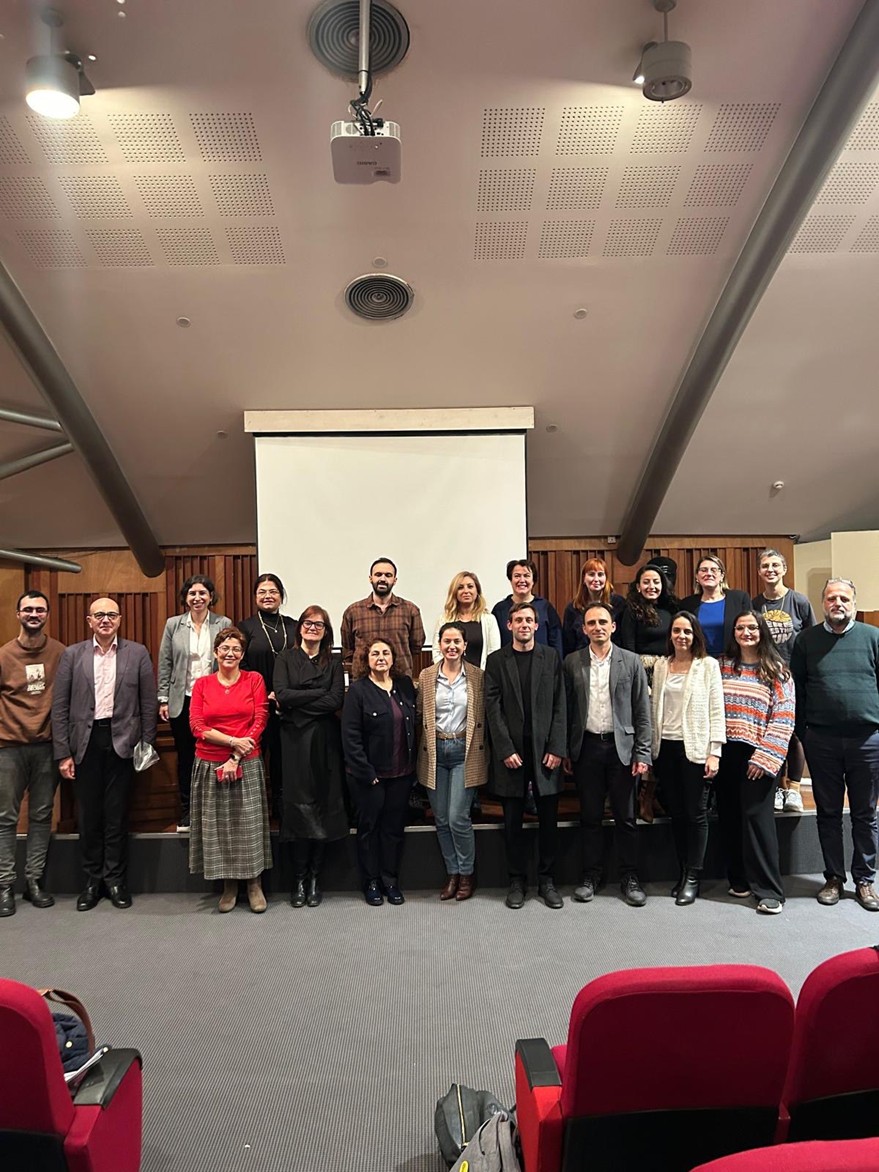
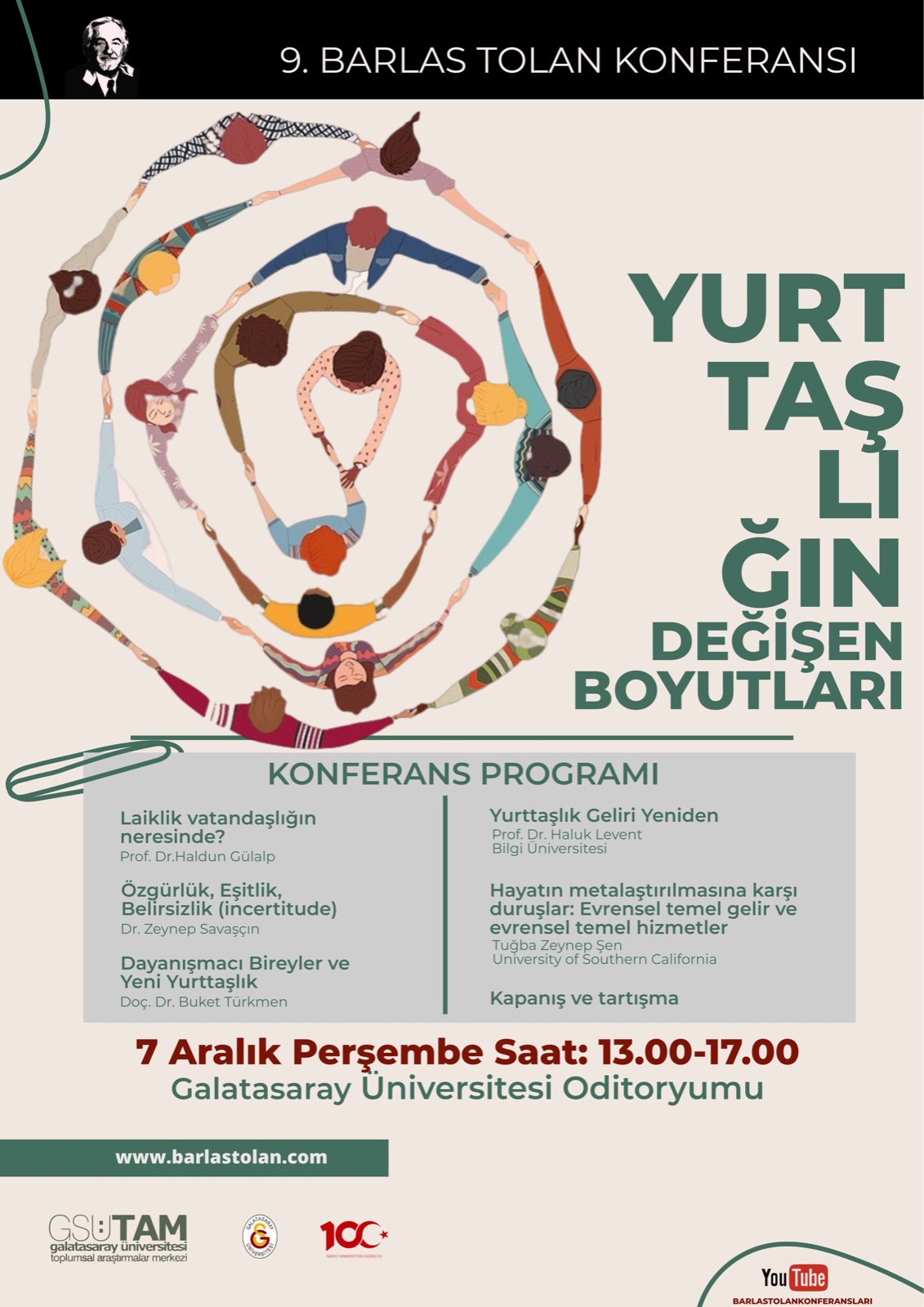
The ninth edition of the Barlas Tolan Conferences, dedicated to the theme “The Changing Dimensions of Citizenship,” began with the opening remarks of Assoc. Prof. Dr. Feyza Ak Akyol. In her speech, she emphasized Barlas Tolan’s vision of gathering around a round table as equal participants — an approach that represented the egalitarian relationships he established with all members of the department from its very foundation.
Prof. Dr. Haldun Gülalp began his talk by noting that he had not had the opportunity to meet Professor Tolan personally, but that he remembered hearing about him with great respect during his years at the Ankara Academy of Economics and Commercial Sciences. Gülalp delivered a rich presentation exploring why secularism constitutes a central element of the principle of equal citizenship, supporting his argument with legal examples.
In the second session, Dr. Zeynep Savaşçın, a faculty member from the Department of Philosophy at Galatasaray University, discussed how contemporary theories of democracy (Ş. Benhabib, E. Balibar, C. Colliot-Thélène) open up possibilities for rethinking the public sphere and the republic today through their approaches to human rights as the foundation of citizenship, rights as intersubjective “claims,” and the notion of “citizen-to-citizen relations.”
Prof. Dr. Buket Türkmen, one of the founding members of our department, examined through various examples how new forms of citizenship can emerge within horizontal forms of organization, particularly in periods when channels of intervention, opposition, and critique within the system are closed.
In the third session, Prof. Dr. Haluk Levent from the Department of Economics at Istanbul Bilgi University presented the main aspects of the basic income debate through contemporary examples. Tuğba Zeynep Şen, one of the graduates of our department who is currently pursuing her doctoral studies at the University of Southern California, drew on her article published in issue 102 of Cogito magazine to discuss the alternatives proposed against the commodification of all aspects of life within the current stage of the basic income debate.
Nazlı Ökten, one of the organizers of the conference, concluded the event with closing remarks in which she thanked Assoc. Prof. Dr. Didem Danış for initiating the idea of addressing the theme of citizenship. She also emphasized the importance of continuing to think and conduct research, and of preserving hope during these challenging times that both our country and the world are going through.
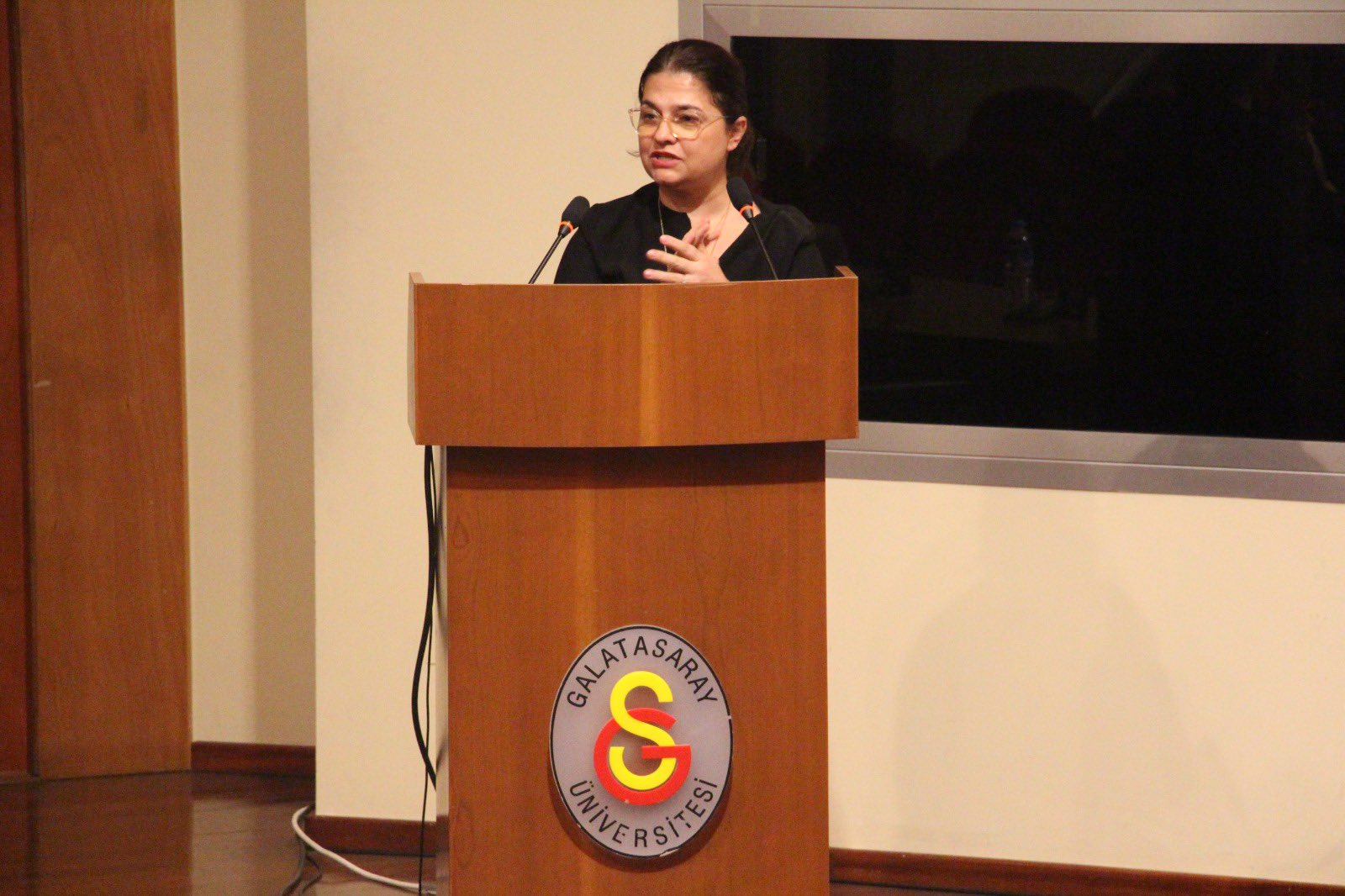
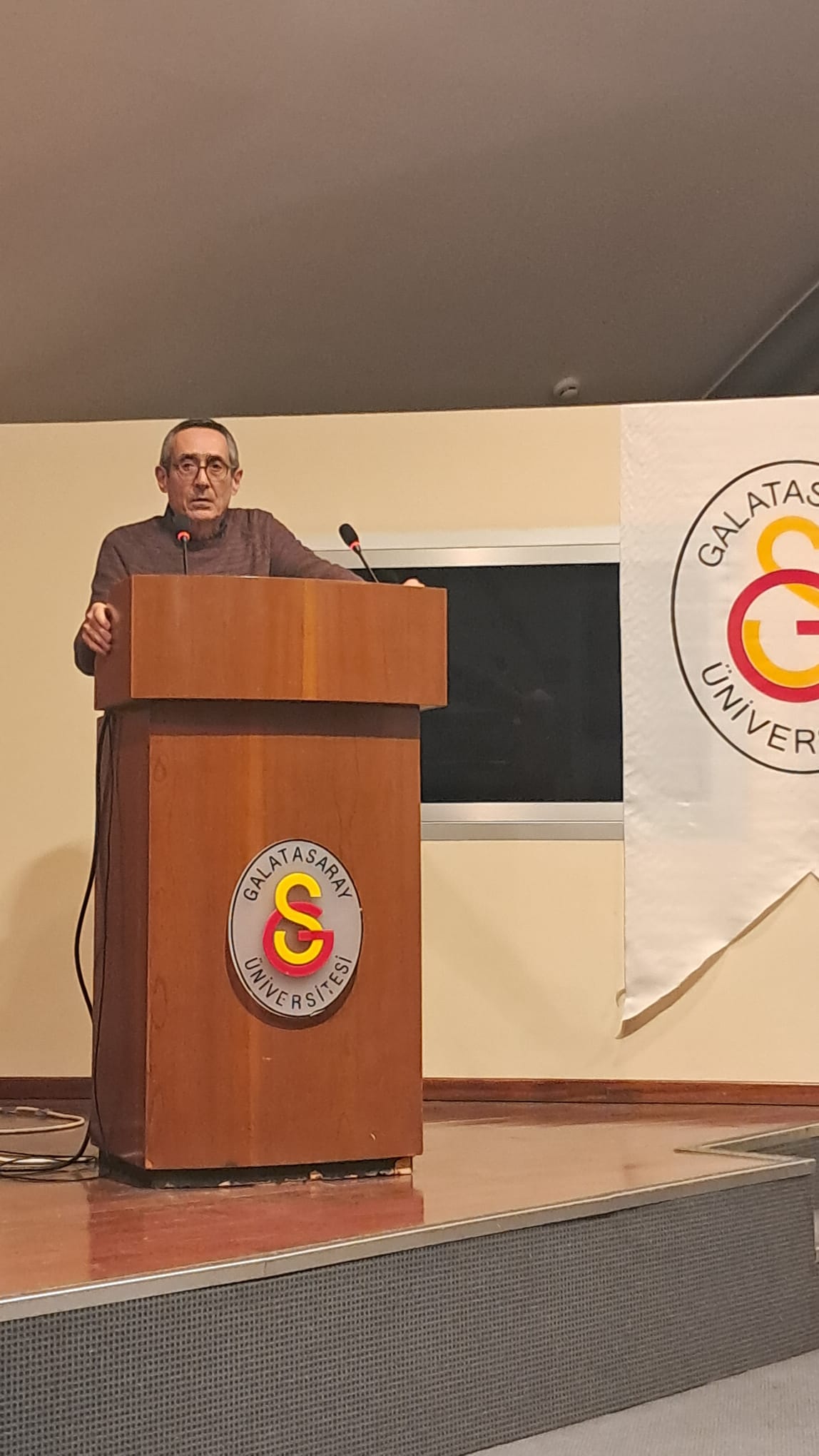
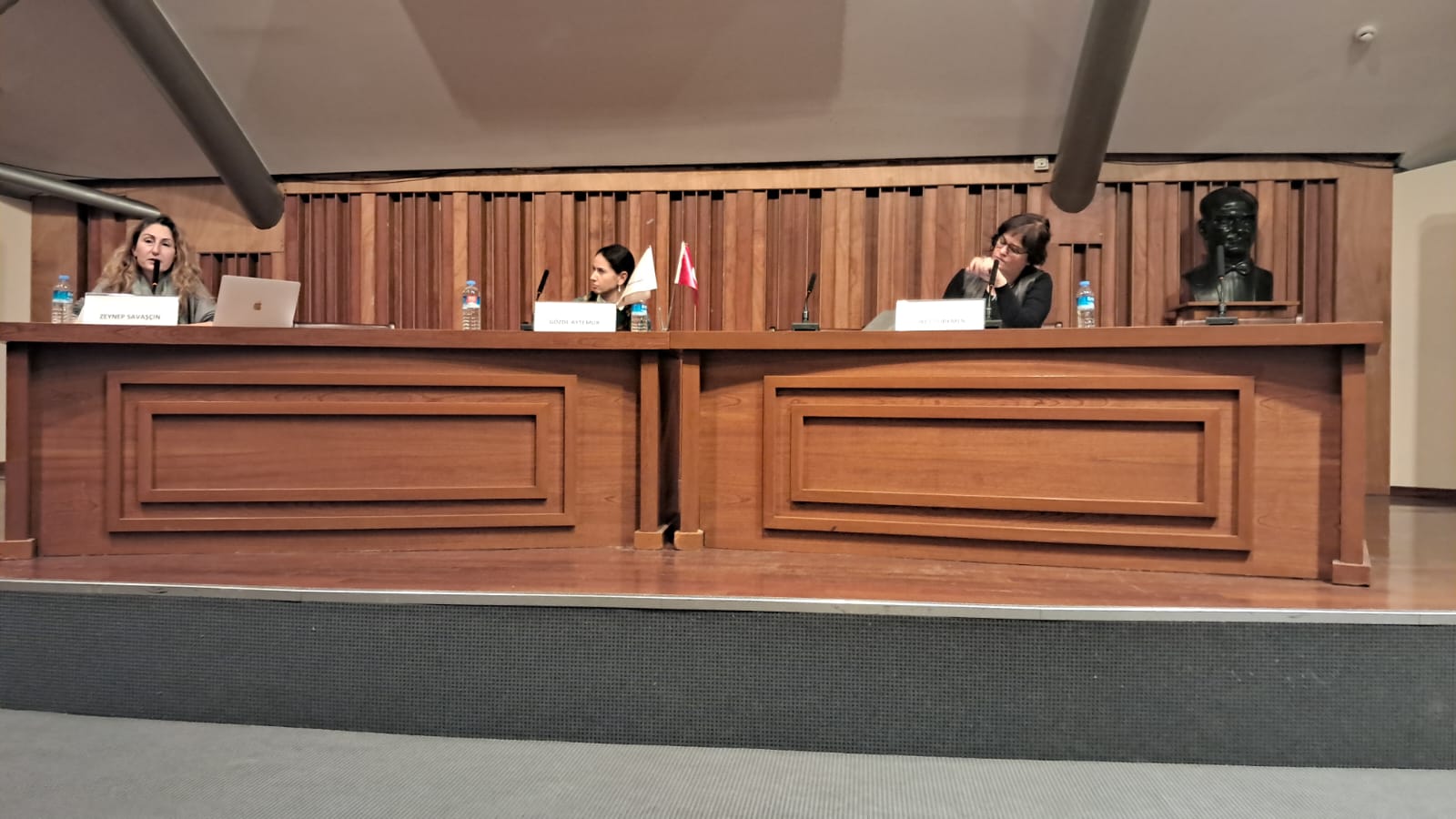
Due to the global pandemic, the sixth and seventh conferences in the Barlas Tolan Conference series, which we were determined to continue with commitment and perseverance, were held online. With the 8th Barlas Tolan Conference, we came together again in person. One of the oldest and most significant events organized by the Department of Sociology at Galatasaray University, the conference was held to commemorate Barlas Tolan, the founding chair of the Department of Sociology, who made invaluable contributions to the establishment and development of Galatasaray University, on the eighth anniversary of his passing.
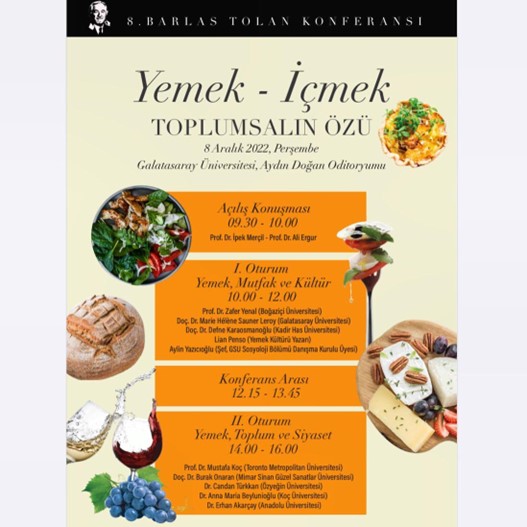
The conference brought participants together under the title “Eating and Drinking: The Essence of the Social.” Through the examples of eating and drinking, we discussed how social reality itself lies beneath the ordinary and the familiar. The conference opened with a speech by Prof. Dr. İpek Merçil, Head of the Department of Sociology. Merçil emphasized the importance of keeping Barlas Tolan’s memory alive. Prof. Dr. Ali Ergur highlighted the importance of examining food and eating practices sociologically and shed light on the integrative power of the table. Following the opening remarks by Prof. Dr. İpek Merçil and Prof. Dr. Ali Ergur, the first session of the conference began.
The first session of the two-part conference, entitled “Food, Cuisine, and Culture,” was moderated by Prof. Dr. Zafer Yenal. Yenal underlined the extent to which everyday life is political and discussed the significance of food in this context. Assoc. Prof. Dr. Marie Hélène Sauner Leroy presented her field research conducted with religious and non-religious women, emphasizing the importance of examining food preparation practices from a gender perspective. She also discussed the extent to which culinary practices have changed across generations.
Assoc. Prof. Dr. Defne Karaosmanoğlu examined discourses of locality and cosmopolitanism through various examples of gastro-racism and populism, highlighting how the local is reconstructed. Lian Penso emphasized the significance of minority cultural heritage elements that have remained behind closed doors, demonstrating the value of festive dishes and ancestral recipes. She also highlighted the unifying aspect of food. Finally, Aylin Yazıcıoğlu, drawing on her own experiences as a chef, discussed how cooking — traditionally associated with women and the private sphere — has become masculinized in the public sphere. She explored what Istanbul cuisine represents and means.
The second session, entitled “Food, Society, and Politics,” was moderated by Dr. Erhan Akarçay. Prof. Dr. Mustafa Koç discussed unequal access to food caused by capitalist food policies. Prof. Dr. Burak Onaran examined food policies in the Soviet Union and explored how eating practices were transformed through these policies, demonstrating the impact of politics and markets on social life. Dr. Candan Türkkan explained how the state shapes who should consume what and how much, particularly through the framework of the minimum wage, and discussed the role of the state in food distribution.
Following this, Dr. Anna Maria Beylunioğlu, drawing also on her professional experience as a chef, invited participants to reflect on ethnic cuisines and locality. After two productive sessions, the conference concluded with the closing remarks of Prof. Dr. Ali Ergur.
The conference can be accessed through the following link:
https://www.youtube.com/@barlastolankonferanslari5225/videos
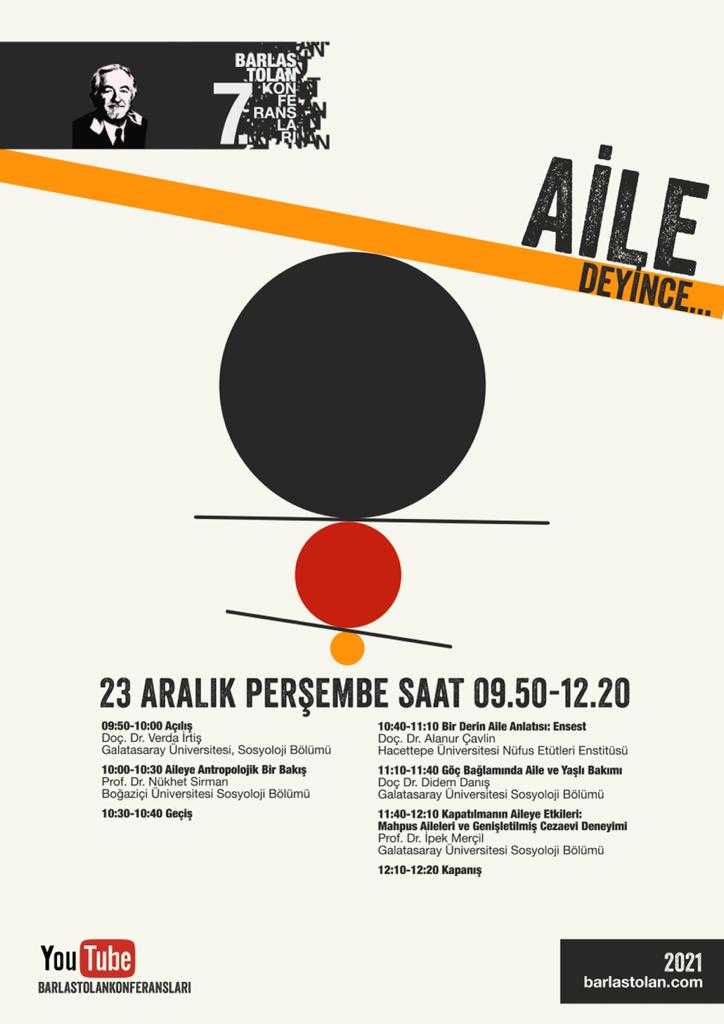
Following the passing of Prof. Dr. Barlas Tolan on 7 December 2014 — the founding Vice-Rector of Galatasaray University and the founding Chair of the Department of Sociology — we organized the seventh edition of the Barlas Tolan Conferences this year, continuing this annual tradition without interruption.
Held remotely, as in the previous year, on Thursday, 23 December 2021, from 09:50 to 12:20, the conference entitled “When We Talk About Family” brought together valuable contributions from Nükhet Sirman, Verda İrtiş, Alanur Çavlin, Didem Danış, and İpek Merçil, who shared their distinguished research and perspectives on the topic.
The conference can be accessed through the following link:

Following the passing of Prof. Dr. Barlas Tolan on 7 December 2014 — the founding Vice-Rector of Galatasaray University and the founding Chair of the Department of Sociology — we organized the sixth edition of the Barlas Tolan Conferences this year, continuing this annual tradition without interruption.
Held remotely this year on Saturday, 19 December 2020, from 10:30 to 13:00, the conference entitled “Pandemic, Lockdown, Confinement” featured valuable contributions from Umur Talu, Feyza Ak Akyol, Selim Badur, Göksel Altınışık Ergur, and Ceylin Özcan, who shared their distinguished research and perspectives on the topic.
The conference can be accessed through the following link:
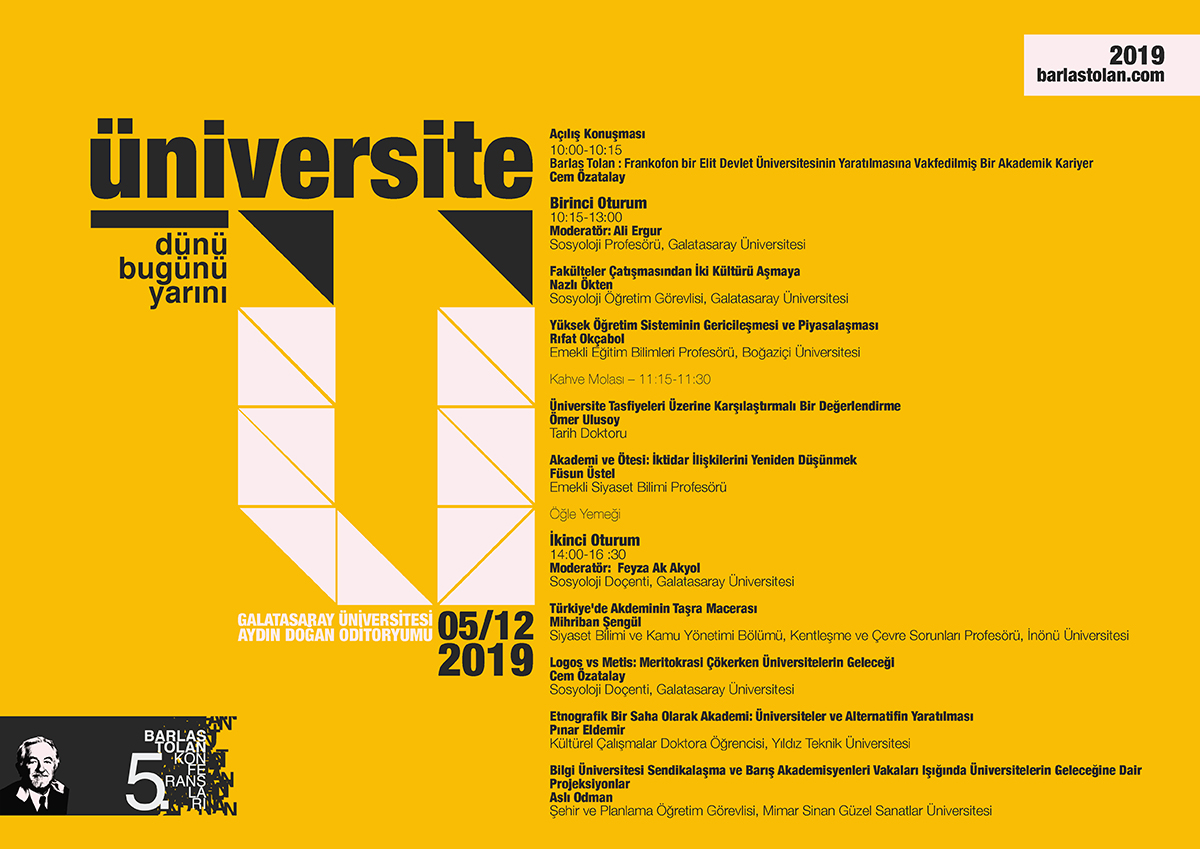
One of the few individuals who contributed to the establishment process of Galatasaray University from its very beginning, Barlas Tolan was commemorated on the fifth anniversary of his passing with a conference organized by the faculty members of the Department of Sociology, which he also founded. Held on 5 December 2019 at the Aydın Doğan Auditorium of Galatasaray University from 10:00 to 16:30, the conference entitled “The University: Past, Present, and Future” brought together some of Barlas Tolan’s classmates from Galatasaray High School and his siblings, his colleagues from the Department of Sociology at Istanbul University, faculty members from various universities, and students.
In his opening remarks on behalf of the Department of Sociology at Galatasaray University, Cem Özatalay addressed the fact that Barlas Tolan’s efforts and contributions to the establishment of the university have been overlooked at the institutional level. He emphasized that this situation cannot be considered separately from the distance and contradiction between the current state and trajectory of universities in Turkey and around the world, and the ideal of the university that Tolan embraced.
Özatalay stated that, for the same reason, the discipline of sociology — like all social science disciplines that do not constitute centers of attraction in terms of being “market-friendly” — is being pushed toward the margins of the university field. He added that the annual conferences organized in Barlas Tolan’s name are regarded as an expression of the conatus of the Galatasaray Sociology Department, that is, its “effort to persist in its existence.”
Thanking all speakers and participants for becoming part of this effort and for their contributions, Özatalay concluded his remarks by inviting Ali Ergur, Head of the Department of Sociology, to the podium to open the first session.


One of the intellectual founders of Galatasaray University, who made significant contributions to its establishment and development, and the Founding Chair of the Department of Sociology, Prof. Dr. Barlas Tolan, was commemorated on the fourth anniversary of his passing on 8 December 2018. In 2015, we launched the Barlas Tolan Conference series in memory of our esteemed professor, and this year we organized its fourth edition.
As part of the 150th anniversary celebrations of Galatasaray High School and the 25th anniversary of the establishment of Galatasaray University, the theme of this year’s conference was chosen as “Galatasaray as an Educational Institution: From Mekteb-i Sultani to the University.” The conference was held on Thursday, 20 December 2018, at the Aydın Doğan Auditorium of Galatasaray University.
Prof. Dr. Barlas Tolan, the Founding Chair of the Department of Sociology, who made significant contributions to the establishment and development of Galatasaray University, passed away on 8 December 2014. The Barlas Tolan Conference series, organized by the faculty members of the Department of Sociology since 2015 in memory of our esteemed professor, continued this year as well.
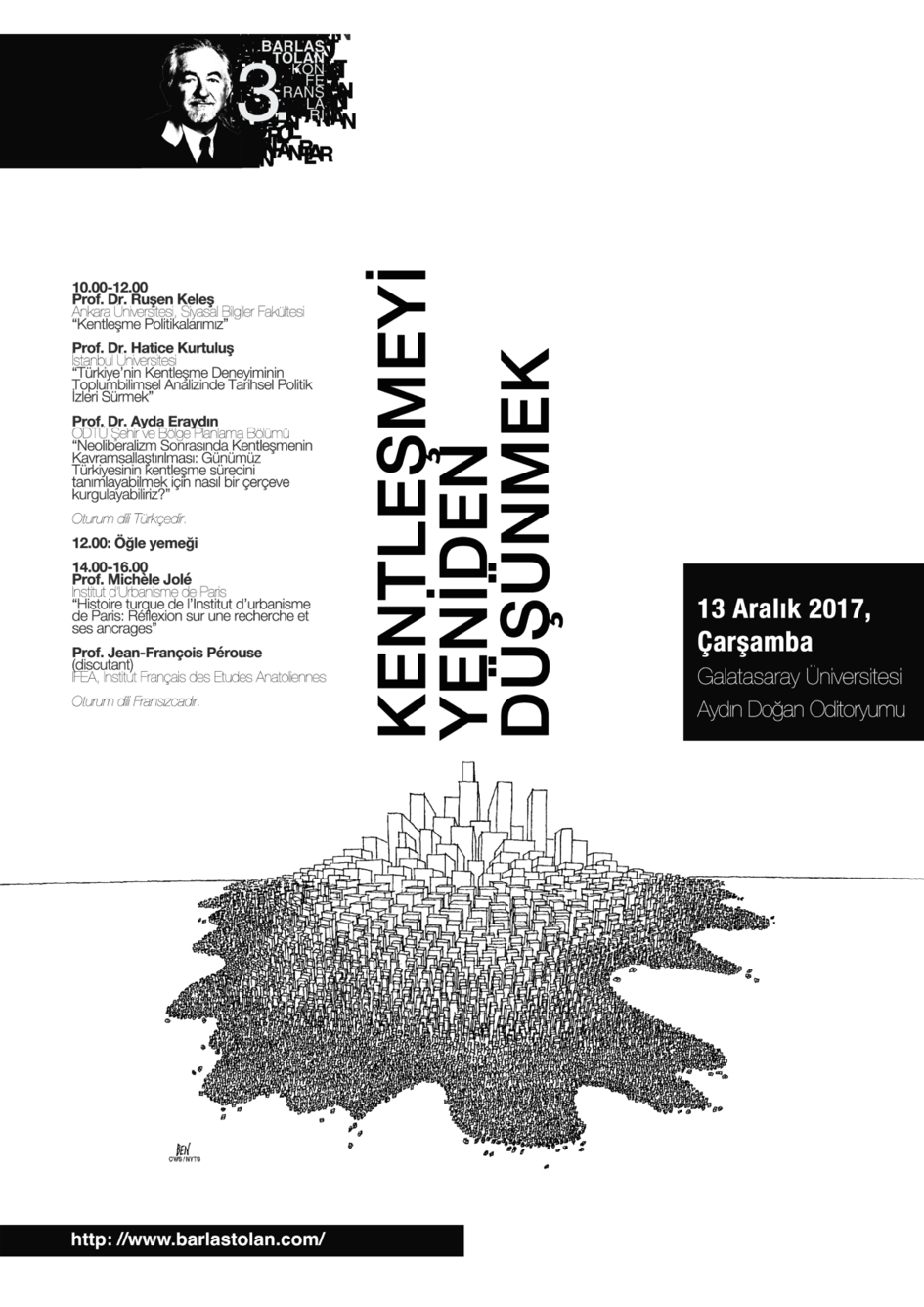
The conference entitled “Rethinking Urbanization” was held on Wednesday, 13 December 2017, at the Aydın Doğan Auditorium of Galatasaray University.
The morning session, which began at 10:00, opened with Ruşen Keleş from the Faculty of Political Sciences at Ankara University, who delivered a talk entitled “Our Urbanization Policies.” Hatice Kurtuluş from the Faculty of Political Sciences at Istanbul University also contributed to the conference with her presentation entitled “Tracing Historical and Political Trajectories in the Sociological Analysis of Turkey’s Urbanization Experience.”
Following these two presentations, which approached the topic primarily from a historical perspective, Ayda Eraydın from the Department of City and Regional Planning at Middle East Technical University delivered a talk entitled “Conceptualizing Urbanization after Neoliberalism: What Kind of Framework Can We Develop to Understand the Contemporary Urbanization Process in Turkey?”
AFTERNOON SESSION
The afternoon session of the conference, which was held in French, began at 14:00. Michèle Jolé from the Institut d’urbanisme de Paris (Paris Institute of Urban Planning) participated as the speaker, while Jean-François Pérouse took part as the discussant.
Jolé shared with the audience her presentation on urban studies on Turkey conducted within the framework of the Institut d’urbanisme de Paris. The conference concluded with Jean-François Pérouse’s observations and the discussion he initiated in response to Jolé’s presentation.
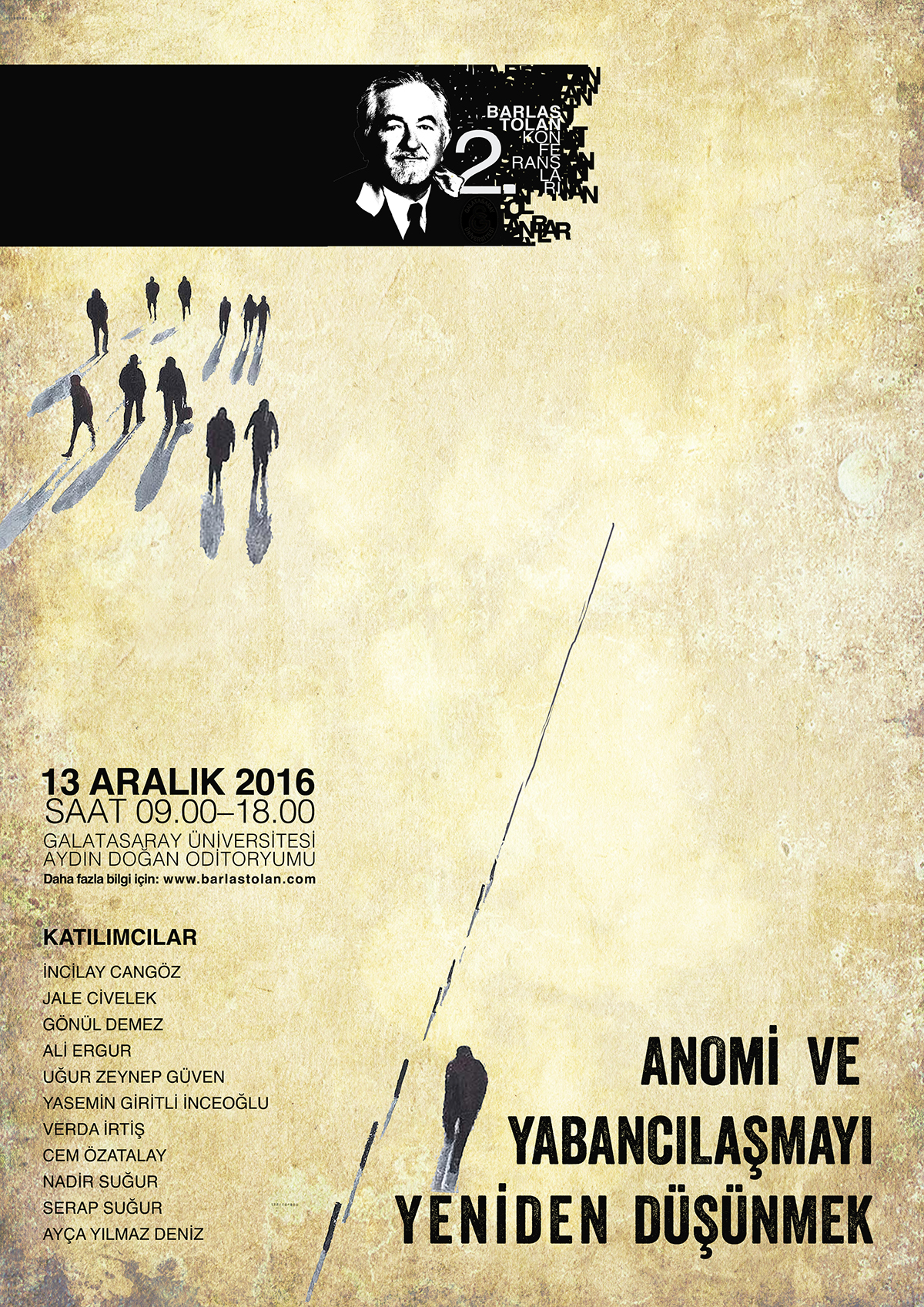
The second edition of the Barlas Tolan Conference, held this year, addressed the concepts of “Anomie” and “Alienation” from different perspectives. The conference, held on 13 December 2016 at the Aydın Doğan Auditorium of Galatasaray University, began with opening remarks by Verda İrtiş on behalf of the Department of Sociology at Galatasaray University, Ali Ergur on behalf of the Faculty of Arts and Sciences at Galatasaray University, and Jale Civelek from the Department of Political Science and International Relations at Yeditepe University.
In the morning session entitled “Theoretical Developments in Sociology in the Network Society,” Nadir Suğur from Anadolu University delivered the first presentation. Reinterpreting the historical development of sociology through epistemological dichotomies and divisions, Suğur argued that the emergence of sociological tendencies seeking to overcome the agent–structure and micro–macro dichotomies since the final decades of the twentieth century should be understood in relation to the replacement of the modernization problematic by the problematic of globalization.
Following Suğur’s presentation, Cem Özatalay from Galatasaray University based his talk on Barlas Tolan’s work entitled The Crisis of Contemporary Society: Anomie and Alienation. He first discussed whether Tolan’s use of the concepts of anomie and alienation to explain the same phenomenon was theoretically appropriate; he then questioned whether Tolan’s central objective — reconciling Durkheim and Marx — could be achieved through these two concepts.
Özatalay argued that if alienation is understood not as the loss of subjectivity but rather as the loss of objectivity, the concept can be employed not together with Durkheim’s notion of anomie, but alongside his concept of egoism.
The third speaker, Verda İrtiş, examined how law has been conceptualized within the discipline of sociology from a historical perspective. After discussing the Durkheimian understanding of law and the concept of anomie, which constitute key references in Barlas Tolan’s sociology, she addressed the distinction made by Jacques Commaille, one of the leading figures in contemporary sociology of law, between “law as a reference/reason” and “law as a resource.”
İrtiş highlighted the democratic potential of the approach of “law as a resource,” which views law as embedded in social relations and seeks to respond to the needs of individuals who constitute society, thereby contributing to the democratization of the legal field.
The final speaker of the morning session, Gönül Demez, first pointed out the connection between Durkheim’s concept of restorative law and probation practices, and then discussed the findings of her research conducted in Antalya. She particularly emphasized the inadequacies of confinement practices in the reintegration of young people struggling with substance addiction into society.
Drawing on international examples as well, Demez concluded her presentation by highlighting the possibilities offered by probation practices as a form of restorative justice.

Following the morning session of the conference, the afternoon session entitled “Contemporary Manifestations of Anomie and Alienation” began with the opening remarks of Yasemin Giritli İnceoğlu, who drew attention to the relationship between the concept of alienation and the term “post-truth,” selected as the word of the year by the Oxford Dictionary in 2016.
The first presentation of the afternoon session was delivered by İncilay Cangöz from Anadolu University in Eskişehir. Examining the importance of communication for those in positions of power from a historical perspective, Cangöz continued her presentation by providing examples from contemporary news-making practices and engaging in a discussion on the relationship between media and alienation.
The second speaker of the session, Ayça Yılmaz Deniz, addressed contemporary manifestations of alienation through the experiences of white-collar workers in professional life. She first referred to Barlas Tolan’s studies on working life, particularly Industrial Workers in Eskişehir (1984) and The Economic Position of Youth in the Process of Modernization: Attitudes and Values (1986). Yılmaz emphasized the importance of Tolan’s research in providing data on issues of precarity and recognition.
In this context, Yılmaz highlighted that within today’s precarious forms of work organization, alienation emerges in different ways: either as a loss of meaning associated with the erosion of character caused by the disappearance of long-term emotions and plans, or as a form of unhappiness resulting from the tendency to ignore workplace problems and injustices as a way of coping with them.
The final speaker of the afternoon session, Uğur Zeynep Güven, delivered a presentation based on Barlas Tolan’s urban studies, drawing attention to the polycentric character of the contemporary city. Pointing out that the fragmented structure produced by the polycentric nature of industrial urban spaces gives rise to different urban cultural communitas with varying degrees of temporariness across different spatial contexts, Güven concluded her presentation by emphasizing that, due to the interrelationship between the city, spatiality, and culture, urban studies inevitably require a multidisciplinary perspective.
After the completion of the afternoon session, the conference concluded with a presentation by Jale Civelek, who had also worked as Barlas Tolan’s colleague at the same institution for many years. Civelek problematized whether the concept of anomie could be used to understand the crises experienced in today’s international society.

We commemorated the late Prof. Dr. Barlas Tolan, the founder of our department, with a meeting held on 8 December.
At the meeting entitled “The Transformation of Sociology in Turkey,” faculty members from our department — Prof. Dr. Ali Ergur, Assoc. Prof. Dr. Cem Özatalay, and Lecturer Nazlı Ökten — discussed the trajectory of sociology in Turkey and the ways in which universities have approached the discipline.
Following the meeting, the Barlas Tolan Library, established through the initiative of Assoc. Prof. Dr. Feyza Ak Akyol with the support of our students, was inaugurated, and the website prepared in memory of Barlas Tolan was introduced. The website, accessible at www.barlastolan.com, contains information, documents, and photographs related to Barlas Tolan.
You can also share your thoughts or memories about Barlas Tolan on this website, which aims to preserve and keep alive his legacy.