The first session of the workshop entitled ‘Objects of Encounter: Balkan Materialities at Mucem’, held at Mucem
On March 26 and 27, 2026, the first session of the international research workshop Objects of an Encounter: Balkan Materialities at the Mucem was held at the Mucem in Marseille. This workshop provided a shared framework for research and discussion, bringing together scholars from various disciplines working on the Balkans, the Mediterranean, museum collections, and material culture studies. The event aimed to examine—based on objects selected from the museum’s reserves—the processes of materiality, memory, circulation, classification, and representation.
The workshop was organized by Melody Robine (EHESS), Juliette Ronsin (EHESS–Mucem), and Oriane Girard (Aix-Marseille University). Participants included Julie Alev Dilmaç (Galatasaray University), Fabio Giomi (CETOBaC–EHESS), Maria Ioannou (Institute for Mediterranean Studies, University of Crete), Gizem Inanç (Galatasaray University), Gizem Kosova (Galatasaray University), Velina Minkoff (CETOBaC–EHESS), Nikos Sigalas (Institute for Mediterranean Studies, University of Crete), Beyzanur Solmaz (CETOBaC–EHESS), and Caner Torun (Institute for Mediterranean Studies, University of Crete).
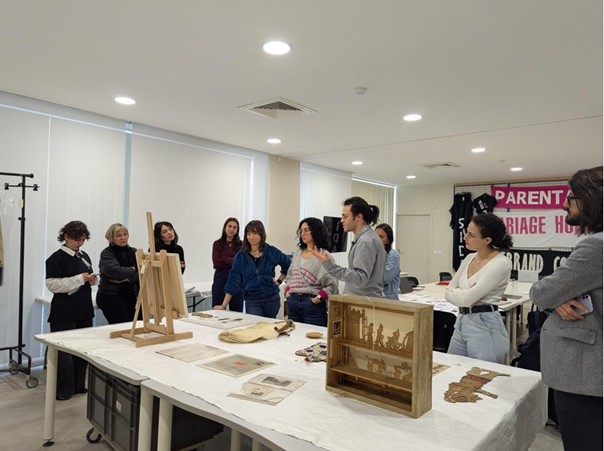
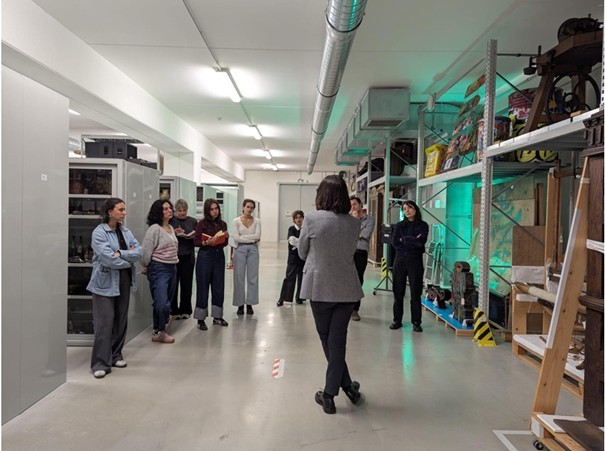
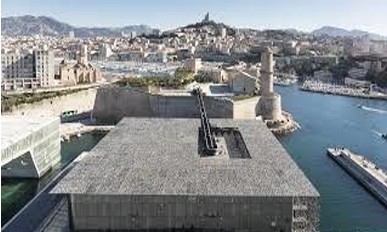
The first day of the program took place at the Mucem’s Centre for Conservation and Resources (CCR), where a visit to the storage facilities was organized and the selected objects were examined in the consultation room. This initial phase enabled direct work on the collections, as well as the articulation of the objects’ material, historical, and museological dimensions. The second day was held at the Mucem Lab, at Fort Saint-Jean, in the form of a working meeting devoted to initial observations, bibliography, the formulation of research questions, and the development of a shared methodological framework around the selected objects. The program also included a guided tour of the exhibition Mediterraneans.
The academic framework of the workshop was structured around the question of how objects can be understood in their social, historical, and cultural dimensions. From this perspective, objects were approached not only as elements of collections, but also as research materials linked to processes of belonging, circulation, classification, the writing of history, and cultural representation. The dialogue established between sociology, history, anthropology, museum studies, and cultural studies thus opened up a space for comparative and interdisciplinary work on the Balkans and the Mediterranean.
The participation of doctoral students in sociology from Galatasaray University in this workshop is part of a broader dynamic of interinstitutional academic cooperation and international research. A second session of the workshop is planned for June or September 2026, also at the Mucem. This upcoming meeting is expected to provide an opportunity to continue the individual research projects initiated on the basis of the selected objects, as well as the methodological discussions and the collective analytical process launched during this first session.